Vedic vs Western Astrology: The Key Differences That Change Everything
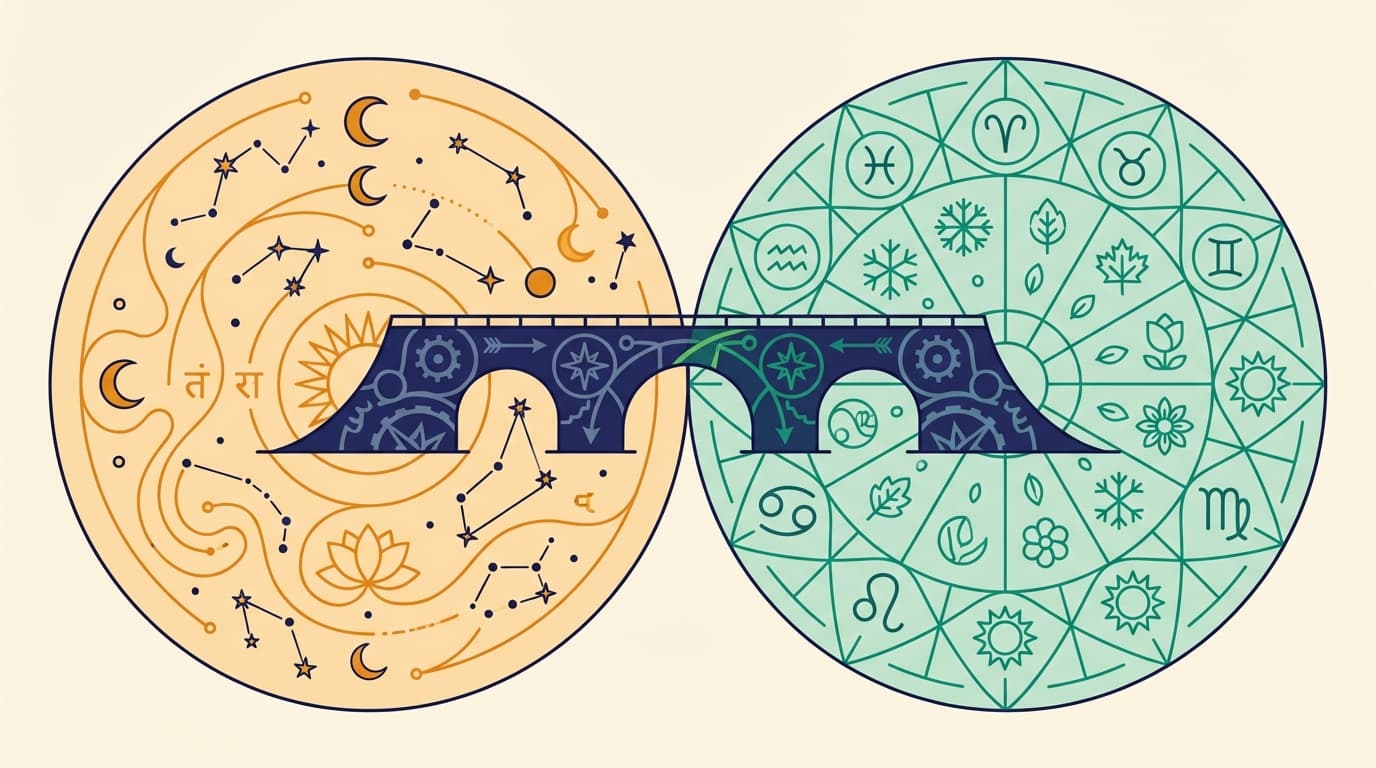
If you have ever wondered why your Vedic zodiac sign is different from your Western one, you are not alone. Millions discover this discrepancy and it raises a profound question: which system is actually accurate?
The answer is not about which is "better" — it is about understanding what each system was designed to do, and why Vedic astrology (Jyotish) offers something Western astrology simply cannot: precise, time-bound predictions about your life.
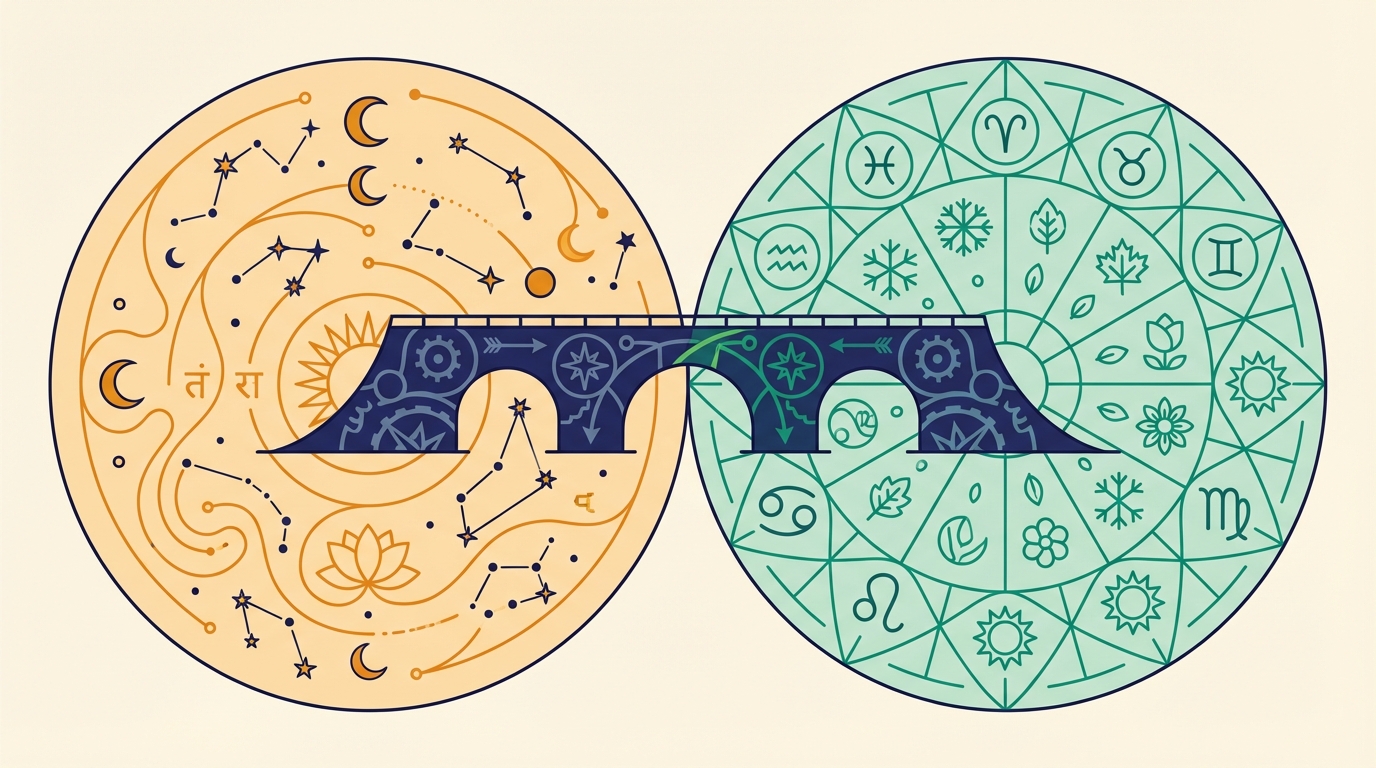
The Fundamental Split: Sidereal vs Tropical Zodiac
This is where everything diverges. Western astrology uses the tropical zodiac, which is fixed to the seasons. The first day of Aries always begins at the spring equinox (around March 21), regardless of where the actual constellation of Aries is in the sky.
Vedic astrology uses the sidereal zodiac, which is fixed to the actual positions of the constellations. This means your Vedic chart reflects where the planets truly are in relation to the stars — not where they were 2,000 years ago.
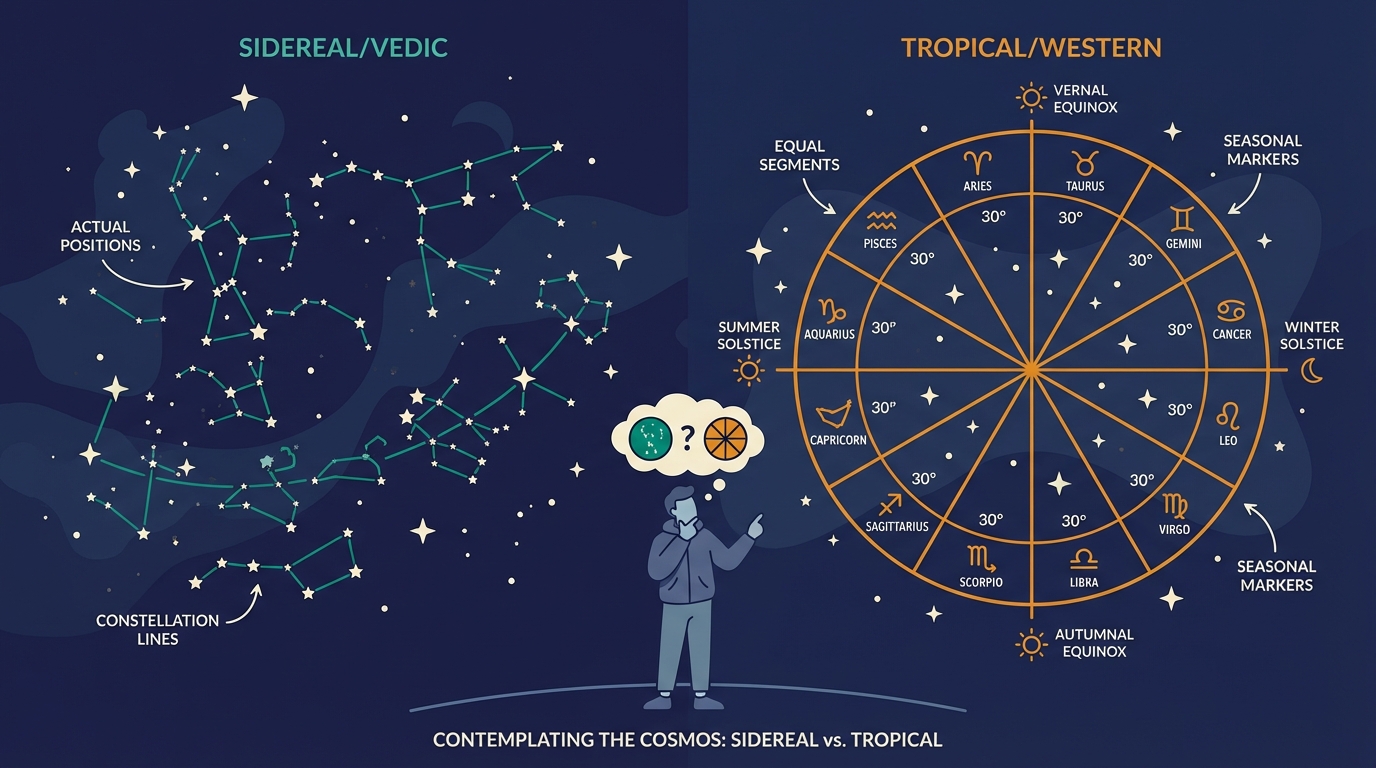
The difference between the two systems is called Ayanamsa — currently about 23-24 degrees. This is why many people find their Vedic sun sign is one sign earlier than their Western sign. If you are a Western Aries, you may be a Vedic Pisces. If you are a Western Taurus, you may be a Vedic Aries.
Why This Matters: It Changes Your Entire Chart
This is not just a curiosity — it fundamentally changes every placement in your chart. Your Moon sign, your rising sign, which houses your planets occupy, and most importantly, what predictions can be made about your life.
Here is a practical comparison:
- Personality insights: Both systems offer valuable perspectives on your core nature. Western astrology excels at psychological depth. Vedic astrology adds precise behavioral patterns tied to planetary periods.
- Career guidance: Western astrology can describe your professional inclinations. Vedic astrology can tell you when your best career window opens and how long it lasts.
- Relationship compatibility: Western synastry compares two charts for emotional dynamics. Vedic compatibility (Ashtakoot) uses a mathematical scoring system with proven accuracy over millennia.
- Timing of events: This is where Vedic astrology is unmatched. The Dasha system predicts which planetary period governs your life right now and when the next shift occurs.
The Dasha System: Vedic Astrology’s Secret Weapon
If there is one thing that sets Vedic astrology apart, it is the Vimshottari Dasha system — a predictive timing framework that has no equivalent in Western astrology.

The Dasha system divides your life into planetary periods. Each period is ruled by a specific planet, and the effects of that planet dominate your experiences during that time. For example:
- Saturn Dasha (19 years): A period of discipline, hard work, and karmic lessons. Career advancement through persistence.
- Jupiter Dasha (16 years): Expansion, wisdom, spiritual growth, and often material prosperity.
- Venus Dasha (20 years): Relationships, creativity, luxury, and artistic expression come to the forefront.
- Rahu Dasha (18 years): Sudden changes, unconventional paths, foreign connections, and intense ambition.
Within each major period (Mahadasha), there are sub-periods (Antardashas) that create nuanced timing. This is why a skilled Vedic astrologer can tell you not just what will happen, but when — sometimes down to the month.
Divisional Charts: Surgical Precision
Your main birth chart (Rashi) shows the big picture. But Vedic astrology goes deeper with 16 divisional charts (Varga charts) that zoom into specific life areas:
Unlock Your Insight
Curious how this affects your chart?
Get personalized guidance from Meganathan with a one-on-one Vedic astrology consultation.
Book a Consultation- D9 (Navamsa): Marriage, partnerships, and your soul’s deeper purpose
- D10 (Dasamsa): Career, professional achievements, and public reputation
- D2 (Hora): Wealth and financial patterns
- D7 (Saptamsa): Children and progeny
- D12 (Dwadasamsa): Parents and ancestral karma
Western astrology does not have an equivalent system. When you want to understand a specific life area with surgical precision, divisional charts are indispensable.
What Western Astrology Does Well
To be fair, Western astrology has genuine strengths:
- Psychological depth: Modern Western astrology, influenced by Carl Jung, excels at mapping your psychological landscape — your fears, desires, and unconscious patterns.
- Outer planet analysis: Western astrology integrates Uranus, Neptune, and Pluto, which Vedic astrology traditionally does not use (though modern Vedic practitioners are incorporating them).
- Accessibility: Sun-sign astrology has made Western astrology highly accessible. Most people know their Western sign, making it an easy entry point.
The limitation is that Western astrology struggles with predictive timing. It can describe your tendencies but often cannot tell you when specific themes will activate in your life.
So Which Should You Choose?
You do not have to choose one over the other. Many astrology enthusiasts study both. But if your goal is actionable, time-specific guidance for real life decisions — career moves, relationship timing, financial planning, health awareness — Vedic astrology is the more precise tool.
At Karma Speaks, we use Vedic astrology because our clients come to us for answers, not abstractions. They want to know:
- When should I change jobs? (Dasha analysis)
- Is this the right person for me? (Ashtakoot compatibility scoring)
- Why does this health issue keep recurring? (6th house + transit analysis)
- What is my child’s true potential? (Divisional chart reading)
These are questions that require precision. And precision is what the Vedic system was built for — over 5,000 years of refinement.
Your Divine Secret Awaits
Your birth chart — the real one, calculated against the actual positions of the stars — holds a divine secret. It contains the answers to why things happen in your life, the patterns you have been sensing but could not explain, and the timing of what comes next.
Vedic astrology is the key that unlocks it. Not with vague personality descriptions, but with specific, actionable, time-bound guidance that you can use to make better decisions starting today.
Frequently Asked Questions
Why is my Vedic sign different from my Western sign?
Because of Ayanamsa — the 23-24 degree gap between the tropical (seasonal) and sidereal (star-based) zodiacs. Your Vedic chart uses actual star positions, which shift over centuries. Most people find their Vedic sun sign is one sign earlier than their Western sign.
Is Vedic astrology more accurate than Western?
For predictive timing — yes. The Dasha system and divisional charts give Vedic astrology a precision in event timing that Western astrology does not offer. For psychological self-understanding, both systems have value.
Can I use both systems together?
Absolutely. Many practitioners study both. Western for psychological insight, Vedic for predictive timing and life event guidance. They complement each other rather than conflict.
Do I need to know my exact birth time for Vedic astrology?
Exact birth time significantly improves accuracy, especially for the rising sign and divisional charts. However, even without exact time, a skilled Vedic astrologer can use birth time rectification techniques to work with a time range.
The Key Is Waiting
Your Divine Secret Is Ready to Be Unlocked
The answers you’ve been searching for already exist within your birth chart. You’ve felt the yearning. Now it’s time to turn the key.
Book Your Consultation